

 Sistema per ricevere chiamate vocali, sms ed email newsletter dal comune in caso di: allerta meteo, news dal territorio, variazioni su servizi








The Little Jerusalem
The Jews in Pitigliano
Pitigliano was home to the Jews, possibly from the end of the fifteenth century, and became an important refuge center for them in central Italy, together with other feudal places nearby, following the Papal Notes of 1555 and 1569 in the Pontifical State and the measures taken by the Grand Duke of Tuscany in 1570 and 1571. In fact they remained immune to the restrictions in the little independent feudal enclaves at the boundaries of Tuscany and Lazio, such as the Orsini County of Pitigliano, those of the Sforza Santa Fiora, the Ottieri Castell’Ottieri, as well as the Farnese Duchy of Castro. Numerous Jewish families took refuge in these little states, where they were able to live more freely and engage in a business activity, to begin with, as moneylenders. Many of them were bankers, amongst which, notably were relatives of the famous doctor David De Pomis who was in the service of the Orsini of Pitigliano and the Sforza in Santa Fiora. Even in Pitigliano, a group of Jews were so well established, that they constructed a temple in 1598. When, at the beginning of the seventeenth century, the Medici annexed the Grand Duchy of Tuscany and other small counties on the southern borders, the Jews who were residing there were confined in Ghettos. Soon afterwards however, realizing their important role in economic and commercial activities, their status was improved and they were given their fundamental rights, thereby enabling them, in this area, to possess stable assets, all of which was quite exceptional at that time. In the meantime, a slow and constant immigration of Jews toward Pitigliano was taking place from nearby. Most important was the arrival of Jews from the City of Castro, destroyed in 1619 and of which Pitigliano was the moral heir. Other Jews came from Scansano, Castell Ottieri, Piancastagnaio, Proceno and then, in the seventeenth century, from Santa Fiora and Sorano, where the Jewish community was declining, leaving Pitigliano as the one and only Jewish community in the Maremma. In the second half of the eighteenth century, with the enlightened reform of the Lorraine, the new Grand Dukes of Tuscany, the Jews were allowed to take part to some degree in the activities of the Municipality; in this way the Jews were able to have their representatives on the town Council. Pitigliano was the last of the “refuge cities” in the area and these favorable conditions remained for decades, making it possible to develop an exceptional relationship in living together and tolerance between the Jewish population and the Christians, so much so that the small town was called “Little Jerusalem”. The extraordinary relationship between Christians and Jews was definitely cemented by a particular episode in 1799, when the people and the majority of Christians defended the Israelites from the bullying anti-French military that wanted to sack the Ghetto. The 19th century opened with a large demographic expansion in economics and culture for the Pitiglianese Jews which reached a high percentage of the entire population. The Jewish Community’s institutions were reinforced with the foundation of a Library and the Pio Institute Consiglio for charitable projects, thanks to the generous donation received in 1854 from Giuseppe and Affortunata Consiglio. Pitigliano provided Rabbis to various Italian Communities and people at a certain regional level in the Jewish world, such as the brothers Flaminio and Ferruccio Servi, founders of the “Vessillo Israelita”, the first Italian Jewish newspaper, and Dante Lattes, one of the strongest and most versatile figures of Italian Jewish in the 20th century. For commercial reasons, Pitigliano became, in its turn, the center for the dispersion of the Jews in numerous towns in the Tuscan and Lazio Maremma. However, all of them remained attached to the Pitigliano community in which the Synagogue was used for the principal religious festivals. The changing economic and social conditions were the determining factor in the 20th century for the slow and constant emigration of Pitigliano Jews towards cities and bigger centers, until the racial laws and persecution of the last World War accelerated the end of the community and the last little flame died with the closure of the Synagogue in 1960. Nevertheless, during the war, many Jews were saved, thanks to the generous protection of the local population, who offered hospitality, refuge and assistance, despite the risks, in this dark period of history. This closed the long story of tolerance, esteem and very often, friendship and affection between Christians and Jews, which constituted a fundamental value and exemplary Pitiglianese experience. Therefore, in spite of the fact that there are now very few Jews in Pitigliano, the old relationship continues in other forms, from the restoration and conservation of Jewish monuments (the Synagogue, the ritual bath, kosher cellar, kosher butcher, the unleavened bread bakery, the dye-works, the cemetery and the Jewish museum) to the production of Kosher wine in the Pitigliano Cooperative Cellars and the foundation of the Association “Little Jerusalem,” whose goal is the promotion of initiatives for the recognition and appreciation of the Pitigliano story.
(Note provided by Prof. Angelo Biondi).
The Synagogue - – Bet Ha-Kneset
 The synagogue was built in 1598 with funding from the Jew, Leone di Sabato. In the 1960’s the structure collapsed in a landslide and was rebuilt in 1995 thanks to the Municipality of Pitigliano. Today is it rarely used since no “Minian” (10 Jewish men required to justify services) exists in Pitigliano however occasional weddings, bar mitzvah, etc... The Holy Ark, is the most significant part of the synagogue and is situated against the wall that looks towards Jerusalem. The Sefer Torah (Pentateuch) is found within the Ark. The Tevà, or pulpit, is placed in the center of the synagogue with benches surrounding it. The singers sat in a semicircle in front of the Tevà while the women sat behind a wooden railing in the balcony above, in the ‘women’s gallery’.
Information for visits..
Jewish Museum of Culture
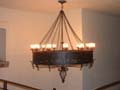 In one room of the Jewish Quarter you will find a small collection of objects used in Jewish traditions. The room where this museum is located has been identified as Pitigliano’s Jewish community’s original place of worship and study.The museum and hallway are painted with murals that illustrate the holy days and ceremonies of the Jewish religion.
The Ghetto
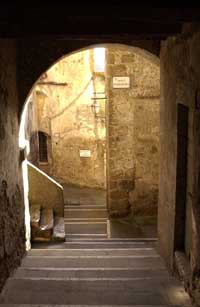 In a fascinating trip through areas carved out of the tuff rock, it is possible to href='index.php?T1=8018&T2=3'>visit these signs of Jewish life. Upon being resettled in this part of Pitigliano, the Jews adapted the already-existent excavated spaces to meet the needs of their community: the ritual bath, the cellar and the butcher house kosher, dye-works and the unleavened bread bakery.
Kosher Butcher
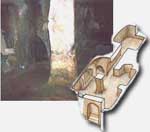 In this room the expert Shochet, or Kosher butcher, slaughtered animals according the Kosher rule. The Torah requires that animals are slaughtered in a precise manner. Only perfectly healthy poultry and cloven-hooves animals such as sheep, goats, cattle and deer are slaughtered by a Kosher butcher. The slaughter takes place very quickly with a quick cut to the jugular vein. After the slaughter (Shechitah), the animals are carefully examined and drained of all blood since Jewish law prohibits the consumption of blood as “blood is life.”
The ritual bath - Miqve'
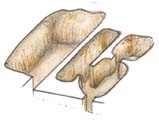 THE RITUAL BATH – MIQVE’
The community built within this room a bath (no longer perfectly identifiable) to contain the rainwater that came out from a hole in the wall at the bottom, allowing the Tevilà (ritual bath). The Miqvè’, or sacred water, can be drawn only from untainted spring water or rainwater. The Tevilà is performed when one converts to Judaism, at the end of the menstrual cycle, before the marriage ceremony and after childbirth. During the Tevilà’ the woman wears nothing that would prevent contact with the water. According to tradition, Tevilà’ takes place in the evening after sunset when stars begin to appear in the night sky. The only exception to this evening rule is when the woman is preparing for her wedding. In every case, the woman must be perfectly clean before immersing herself in the ritual water and bath.
The unleavened bread bakery
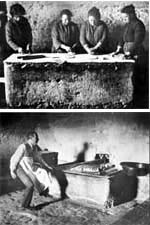 There is a gate at the entrance to the oven, characterized by a grill in the form of a menorah (candelabrum, with seven branches). The oven has two rooms. In the first spaces are located where work of the bodies while the second was used for cooking. This locale was opened once a year for the exclusive use of cooking cakes and unleavened bread for Passover. It was last used for Passover in 1939 before the Jewish community suspended worship due to the racial laws during the Fascist regime. Note on the right side of the bakery’s entry door and again on the right side of the oven door there are two notches at a slight angle.
Kosher Cellar
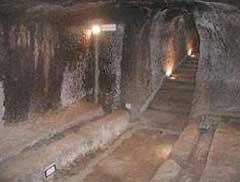 For many years, the long passage leading to a typical Pitiglianese cellar was buried under a heap of rubbish. This location is where the Kosher wine was produced; Kosher meaning ‘can be eaten’ and that the product was prepared according to the rules of the Jewish rite. In the Kosher rule, meat and dairy products cannot be consumed together in the same meal, therefore if a wine containing milk-product additives was drunk at a meal, it would not be acceptable to also eat meat. Kosher wine is pasteurized be acceptable to also eat meat. Kosher wine is pasteurized at a higher temperature than normal and the entire winemaking process from harvest to bottling is strictly controlled.
Dye-Works
Many Jews in Pitigliano were weavers and traders. These rooms were used for dyeing textiles or tanning hides as evidenced by the tanks and water which was found in them. Notice on the right side of the entry door, there is notch at a slight angle where the ‘mezuzah’ was placed.
The Jewish Cemetery
The cemetery goes back to the second half of the XVI century, when Count Niccolò IV Orsini gave a small piece of land to his personal Jewish doctor, Davide De Pomis, who buried his wife there. Strange is the presence of the statue of a girl on his tomb and an angel, In jewish cemetery should there be not representations.
For info: Ass. La Piccola Gerusalemme – 0564614230
“The Little Jerusalem” Association
“The Little Jerusalem” association is a cultural association is a cultural association founded in 1996 by Ms Elena Servi single Jewish woman still living in Pitigliano. The association has as its purpose:
- conservation and enhancement of cultural and artistic heritage of the Jewish community of Pitigliano;
- the upkeep of the Israelite cemetery;
- promotion of cultural and religious activities both of a tourist and a recreational character.
Contacts
Marghera alley – Zuccarelli avenue
Tel./fax: 0564614230 cell. 3281907173
Mail: lapiccolagerusalemme@libero.it
Website: www.lapiccolagerusalemme.it
Facebook: La Piccola Gerusalemme
Hours:
dal 1/04 al 30/09:
10,00 – 13,30
14,30 – 18,30
dal 1/10 al 31/03:
10,00 – 12,30
15,00 – 17,30
Saturday closed.
Last entrance 20 minutes before closing.
During the jewish holidays the Synagogue is visible from the women's gallery, while the rooms of the Ghetto are open.
For visits of larger groups is necessary appointment.
Tickets:
€ 3.00
€ 2,00 (children 6 - 12 years, over 65 years, groups 20 people, university students,)
Free
(invalid, guide, under 6 years and press)

 Servizio mensa scolastica